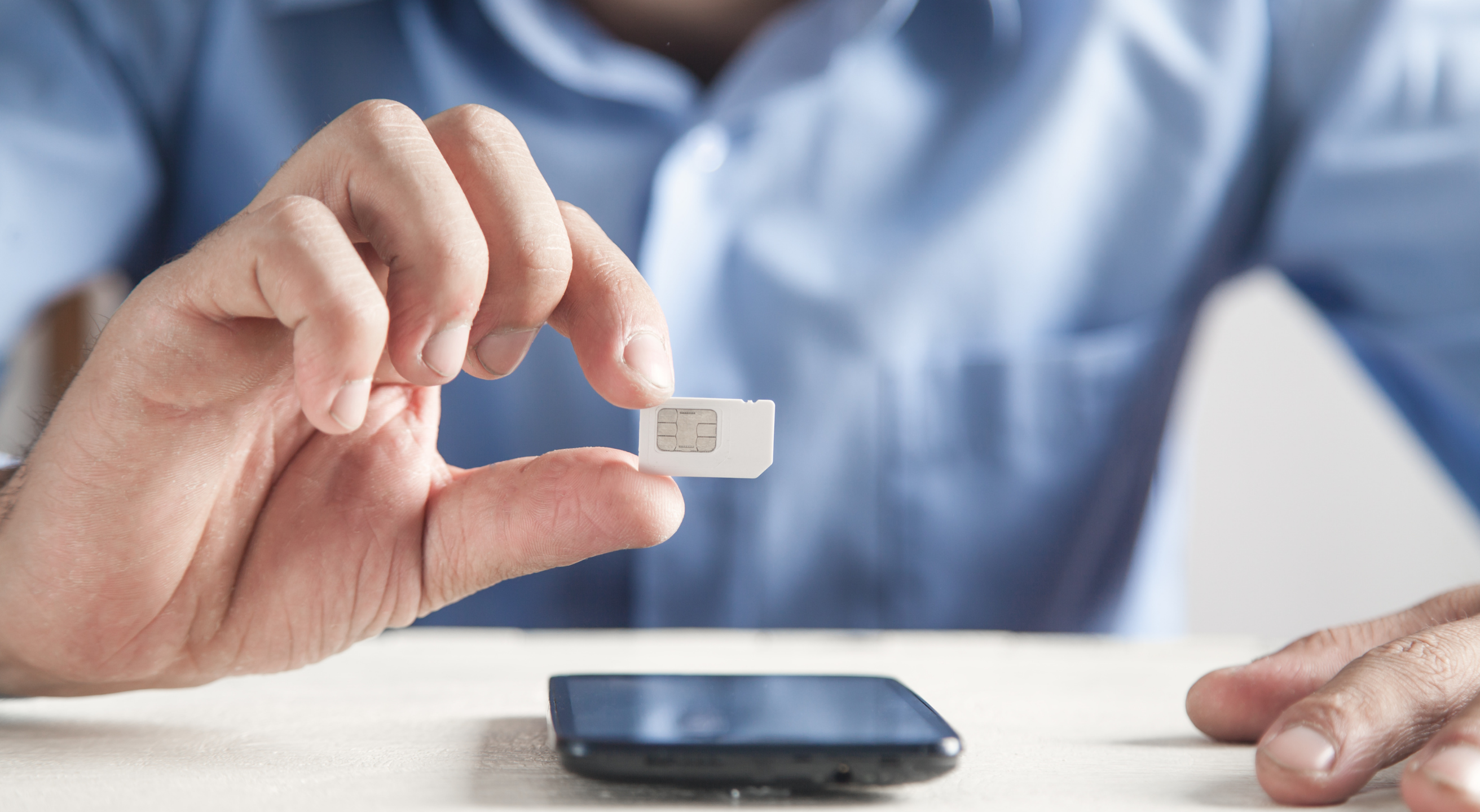
Switching phone numbers or carriers used to mean having to buy and insert a new SIM card into your phone. With eSIMs, you can activate plans and switch carriers digitally, in seconds.
Beyond convenience, eSIMs are less susceptible to theft, less prone to tampering, and easier to manage across multiple networks. This makes eSIMs a generally more secure and flexible choice for modern users.
That said, not all eSIM providers offer the same level of security. The actual protections depend heavily on how your carrier handles your data.
In this guide, we’ll break down the key differences, as well as the pros and cons of eSIMs vs. physical SIMs, and show you what they mean for everyday use.
Understanding eSIM and Physical SIM Technology
Both eSIMs and physical SIM cards serve the same core purpose: they connect your phone to a cellular network. Where they differ fundamentally is in their convenience, security, and flexibility.
The traditional SIM card is a small, removable plastic card that stores unique subscriber data, such as your International Mobile Subscriber Identity (IMSI) and Integrated Circuit Card Identifier (ICCID). When inserted, the device reads this data to authenticate you with your mobile carrier’s network, granting you access to text, calls, and data.
An eSIM, or embedded SIM, is the digital upgrade of the same concept. Instead of a removable card, it’s a tiny Embedded Universal Integrated Circuit Card (eUICC) chip soldered directly onto your device’s motherboard. Your phone still gets the same network identity and connects in the same way, but the SIM profile is downloaded and managed through software rather than inserted manually.
While software-based SIM profile management can offer enhanced security through mechanisms like cryptographic protocols (PKI, AES encryption) and remote deactivation, the level of protection depends heavily on carrier systems.
Legacy carrier infrastructure, loose SIM swap policies, and third-party provisioning can still expose users to account takeovers, social engineering, data routing issues, and other exploits.
eSIM vs. Physical SIM: Quick Summary & Comparison
Here’s a quick overview of how these two technologies stack up across common user scenarios:
Key Characteristics | eSIM | Physical SIM |
Physical form | Embedded chip | Removable plastic card |
Activation process | By scanning a QR code or through carrier software (remote SIM provisioning) | Manual inserting or swapping |
Device compatibility | Only works on phones or devices with eSIM support | Works on all devices with a SIM slot, except some modern eSIM-only phones |
Transfer between devices | Software-based process; may require carrier reactivation | Requires purchasing, inserting, and swapping SIM cards between devices |
Multiple plans and profiles | Supports multiple profiles on one chip | One profile per card; multiple profiles require multiple cards |
Security | Can’t be physically stolen or cloned. Network security depends on digital safeguards and carrier system integrity | Vulnerable to physical theft, SIM cloning, and misplacement |
Ideal use case | Frequent travelers, multi-line users, privacy-conscious subscribers, and those seeking a future-proof setup | Users with older devices, those who frequently swap phones, or those in regions with limited eSIM support |
Pros of eSIM Over Physical SIMs
Because eSIMs are software-based and built into your device, they come with practical benefits you won’t get from a physical SIM card. Here are some of the main advantages of eSIM vs. physical SIM:
- Quick online setup
- Enhanced security
- Network flexibility
- Travel convenience
- Better design efficiency
- Improved sustainability
1. Quick Online Setup
With an eSIM, you activate your plan online by scanning a QR code or using your carrier’s app. The entire process happens over the air and usually takes just a few minutes. Once complete, your phone connects to the network immediately.
This process, known as remote SIM provisioning, lets carriers deliver and update profiles without hardware exchange.
2. Enhanced Security
An eSIM is less prone to loss, theft, or physical tampering by design. Even if someone steals your phone, they can’t just pull out the SIM and use it in another device to misuse your number or receive authentication codes.
eSIMs are also less vulnerable to SIM cloning compared to traditional SIM cards. The identity data on an eSIM is stored in a secure chip with encrypted profiles, making it harder for attackers to clone your identity data even with remote cloning methods.
eSIMs aren’t entirely immune to all threats, though, and can still be hacked through:
- Malware
- Corrupted or infected apps
- Harmful phishing links
- Device hijacking
- Flaws in your carrier’s systems
They’re also as vulnerable to SIM swap fraud as physical SIMs, where a scammer convinces a carrier to port your number to a device they control, often to intercept two-factor authentication (2FA) codes or access accounts.
These attacks work because carriers rely on human verification and basic identity checks, which can be bypassed through social engineering or stolen personal data. The choice of provider plays a key role here. Privacy-focused carriers like Cape are built to address these vulnerabilities.
Cape's SIM Swap Protection completely removes human involvement from the account transfer process. Unlike traditional carriers that rely on easy-to-spoof verification calls, Cape requires a 24-word cryptographic passphrase stored locally on your device before transferring your number, making SIM swaps technically impossible without your verification.
3. Network Flexibility
One of the most practical perks of eSIMs is their ability to store multiple network profiles on a single chip, although only one or two can be active at any given time. The eSIM chip is programmable, so it can be updated and reprogrammed to work with different providers without replacing it.
This feature lets you switch between carriers or plans from your phone’s settings without physical swapping or additional setup, which is especially useful if you:
- Travel frequently
- Want a separate number for business, friends, and family
- Need to change carriers to get better coverage
For example, you can keep your primary carrier active while adding a dedicated data-only eSIM for gaming or a low-cost regional plan for travel. Physical SIMs generally allow only one line per card.
4. Travel Convenience
eSIMs offer practical benefits for international travel. Before going on a trip, you can research and purchase a local data plan and select it for cellular data use (it won’t activate until you reach your destination).
When you arrive, your plan will get activated automatically, and the phone will connect to the local network, saving you the time and hassle of visiting local shops.
This means you can have navigation, translation apps, and messaging ready the moment you step off the plane, all while keeping your regular number active for important calls.
5. Better Design Efficiency
eSIMs free up valuable space inside devices, which manufacturers can use to integrate:
- Larger batteries
- Enhanced thermal management systems
- Additional sensors
- Better water and dust resistance
- Slimmer designs without sacrificing connectivity or durability
Physical SIM trays, by comparison, take up internal room and add several mechanical points of failure: SIM trays can break, hardware connections may fail, physical mountings can get damaged, and dust or moisture can enter the device.
6. Improved Sustainability
The environmental impact of digital SIMs is obvious. eSIMs eliminate plastic production, metal chip fabrication, and individual blister packaging that contribute to global plastic and electronic waste.
Digital SIMs also reduce costs across manufacturing and transport logistics, from factory production to shipping and distribution to millions of customers. The aggregate environmental and financial impact across millions of users and devices globally is meaningful.
Cons of eSIM Over Physical SIM
While there are many practical advantages of eSIM over physical SIM cards, there are also clear drawbacks, especially around compatibility and carrier dependency. eSIM technology usually falls short compared with physical SIM cards in these aspects:
- Limited device and carrier compatibility
- More complex device switching
- Dependency on carrier systems and privacy
1. Limited Device and Carrier Compatibility
The biggest disadvantage of eSIMs is that they aren’t supported on every phone or network yet. Many older and budget models don’t have a built-in eSIM chip, which means you might have to upgrade your device.
You can check if your phone has an EID (eSIM ID) by dialing *#06#. If your device shows an EID number, it supports eSIM functionality. If it doesn’t, you have to stick to a regular SIM.
Still, it's only a matter of time before eSIM adoption becomes universal. Industry analysis from GSMA Intelligence projects that by 2030, more than 76% of global smartphone connections will be through eSIMs as more manufacturers build in support and mobile networks expand their offerings.
2. More Complex Device Switching
While eSIMs make it easy to switch between carriers, the process isn’t as simple when you want to switch phones. In most cases, you can transfer your number using built-in tools or by scanning a QR code. However, in some situations, you may need to go through your carrier to request a new activation code or reassign your number. This adds extra steps and can introduce delays.
The exact steps vary by manufacturer and carrier, but a typical flow looks like this:
- Contact your carrier or use their app to initiate a transfer or request a new QR code for the new device. This step is mostly required when switching between different operating systems
- On your new phone, go to cellular network settings and select Add eSIM or Transfer SIM
- Scan the new QR code shown on your device or follow the on-screen transfer prompts
- Verify the transfer, often by entering a code sent to your old eSIM number
- Confirm the new eSIM is active by making a test call, then delete the old eSIM profile from your previous device
Generally, it’s easier to switch if the devices are from the same manufacturer because they may include built-in OS-level transfer tools. If you want to switch between Android and iOS, you’ll likely need to contact your carrier for approval.
3. Dependency on Carrier Systems and Privacy
Network-level data handling is the most significant consideration for privacy-conscious users. When you use an eSIM from a regional provider or an MVNO, you’re routing all your mobile data, including your browsing, app usage, and location, through that eSIM provider's servers.
Many of these providers may handle your eSIM profiles through:
- Cloud platforms
- Third-party resellers
- Partner networks
This shifts the trust model entirely to your carrier's digital systems and business practices. And not all of them clearly explain how your data is managed. Your personal identifiers, like your IMSI, can be exposed to multiple network partners. There is often a lack of transparency about how long this data is logged, who it’s shared with, or how it is secured en route.
Cape mitigates these risks by operating its own proprietary mobile core and directly managing eSIM profiles, bypassing third-party dependencies for greater transparency and control. In addition, Cape operates on a minimal data policy, storing only the bare minimum information required for service.
eSIM vs. Physical SIM: Which One Is Right for You?
Choosing between an eSIM and a physical SIM comes down to your device, lifestyle, and how you use your phone. Here’s a quick overview to match the right technology to your needs:
Use Case | eSIM or Physical SIM? | Key Reason |
Best for compatibility | Physical SIM | Works on a wider range of phones (including budget smartphones and feature phones) and with nearly every carrier worldwide |
Best for travelers | eSIM | Remote activation of local data plans avoids roaming fees and store visits abroad |
Best for multiple numbers or plans | eSIM | Manage personal, work, and data-only profiles simultaneously on one device |
Best for simplicity | eSIM | Quick digital setup and transfers using app-based tools |
Best for security-conscious users | eSIM | Less risk of physical damage, theft, and SIM cloning |
As more devices now support digital activation and multi-profile management, many users are leaning toward eSIMs for their flexibility, convenience, and security advantages. But built-in security isn’t enough; your privacy still depends on how your carrier handles your data.
Some providers are designed with this in mind. Cape is an eSIM-based carrier built around privacy and security. Its network architecture follows a minimal-trust model, meaning it collects only the data required to provide the service rather than building detailed user profiles.
The plan includes unlimited 4G and 5G data, as well as unlimited calls and texts, all offered at a straightforward monthly pricing with no long-term contracts.
Cape: The Carrier Built for Security and Privacy
Cape is a privacy-first mobile carrier designed to keep your communications safe from surveillance and misuse. Unlike traditional cell phone plan providers, our business model centers around providing you with premium and secure call, text, and data, rather than harvesting and selling your information.
Our service is built from the ground up with privacy and security at its core, offering unique features like:
Privacy & Security Feature | Description |
Cape doesn’t ask for your name, address, or Social Security number. We only collect the information necessary to provide service, and we retain that information for the minimum amount of time possible. | |
Traditional carriers rely on a fixed International Mobile Subscriber ID (IMSI) to connect your device to cellular networks. This is a vulnerability that lets carriers, advertisers, and bad actors identify and track your device. Cape lets subscribers automatically rotate their IMSI every 24 hours, making it infinitely more difficult to track you or your device. | |
Many services ask for your phone number, but sharing it exposes you to spam, scammers, data brokers, and a variety of other risks. VoIPs, on the other hand, don’t work with 2FA, cost extra, and aren’t encrypted. With Cape, you get two free additional SMS/MMS lines that are middle-to-end encrypted. | |
Most U.S. carriers store your call and text metadata for years, sometimes indefinitely. Cape is built to forget, so call data records (CDRs) are deleted after just 24 hours. | |
Cape nullifies the threat of SIM swapping by completely removing humans from the loop. During signup, you receive a 24-word phrase that generates a private key tied to your number. This effectively means that no one (but you) can move your number to a new carrier or device, not even Cape. | |
Legacy network protocols, like SS7, leave you vulnerable to hackers that can track your location, intercept your calls and texts, and steal sensitive information. Cape’s Network Lock relies on a proprietary signaling proxy to verify that your device’s physical location matches the network it’s trying to attach to. If we detect anything out of the ordinary, Cape automatically blocks the connection, nullifying the potential threat. | |
Traditional voicemail systems are outdated, unencrypted, and another security hole bad actors can exploit to gain access to your sensitive information. Cape encrypts all voicemails, ensuring only you can access them. | |
While roaming, your phone connects to local telecom providers to enable service. But, who knows who might be listening on the other end. Cape provides you with peace of mind by routing your traffic through our U.S.-based mobile core, ensuring your identity, data, and communications remain private and secure. |
Ditch Legacy Carriers: Get Cape Today
Cape is a “Heavy” Mobile Virtual Network Operator (MVNO), meaning we own our mobile core and provision our own SIMs. This gives us full control over how accounts are authenticated and what data is collected (and for how long), and is how we are able to provide privacy and security features no other carrier on the market can offer.
Get started with Cape today and enjoy the peace of mind, knowing you are fully protected against scammers, hackers, bad actors, and other mobile threats.
To help protect more than just your phone, we’ve partnered with Proton. As a new Cape subscriber, you can choose between Proton Unlimited and Proton VPN Plus for just $1 for six months.
Share it