
With mobile phones routinely costing well over a thousand dollars, many people are turning to insurance plans to act as a safety net against the unexpected crack, spill, or loss.
Verizon Mobile Protect is a bundled device protection plan that covers loss, theft, damage, and post-warranty issues. But is the added cost worth it?
This Verizon Mobile Protect review provides a detailed look at its coverage, pricing, and claims process, and compares it with popular alternatives, making it easier to decide whether the ongoing monthly cost is justified for your needs.
What Is Verizon Mobile Protect?
Verizon Mobile Protect is a device insurance and extended service package offered to Verizon postpaid customers. The plan combines three separate Verizon add-ons into one monthly subscription:
- Wireless Phone Protection: This is the insurance component of the bundle, administered by Asurion, a third-party insurance provider. It covers loss, theft, and accidental damage.
- Verizon Extended Warranty: It adds post-manufacturer warranty coverage and helps cover repairs or replacements for mechanical and electrical failures. The warranty may also include battery replacements for select devices.
- Verizon Mobile Secure: The add-on provides access to 24/7 tech assistance (via the Tech Coach app), device protection tools (anti-malware and secure VPN), and caller ID and spam call protection through the Verizon Call Filter app on Android and iOS.
You must enroll within 30 days after activating a device to be eligible for the coverage. Verizon also offers a Mobile Protect Multi-Device package that covers up to 20 lines under one plan, so families or accounts with several devices can share benefits.
Verizon Mobile Protect Review: 5 Key Aspects Explained
To evaluate how Verizon Mobile Protects performs in practice, we’ve broken down the service’s offerings across five key areas:
- Coverage
- Policy exclusions
- Plans and pricing structure
- User reviews
1. Coverage
Verizon Mobile Protect offers extensive hardware coverage and support, including the following key benefits:
Category | What’s Included |
Loss and theft protection | Replacements for lost or stolen phones (deductibles applicable) |
Accidental damage | Drops, cracks, water damage, and other accidental damage |
Cracked screens or back glass | $0 deductible cracked screen and glass repair for eligible smartphones |
Post-warranty malfunctions | Coverage for issues like battery failure and internal component damage after the manufacturer's warranty expires |
Included apps and services |
|
It’s clear that the tools included with Mobile Protect focus on device-level convenience rather than broader security risks. Call Filter is meant to block spam calls, but the app itself has been found to contain security vulnerabilities that exposed call records and timestamps of millions of Verizon users.
Moreover, the Call Filter app requires broad device permissions to function, including access to contacts, SMS, and location, feeding this data to Verizon’s backend servers.
Likewise, Mobile Secure promises to protect against malware, but it completely ignores that Verizon’s own security practices have led to multiple breaches in the past, exposing sensitive subscriber information to scammers and unauthorized third parties. Most legacy carriers are built on the same infrastructure, business model, and data practices, which is why the solution is to switch to a privacy-first carrier like Cape.
Cape addresses these gaps directly by limiting data collection, reducing retention, and removing common attack vectors like SIM swaps. Protection occurs at the network level by design, not through an app that operates after exposure has already happened.
2. Policy Exclusions
Verizon’s official policy clearly mentions that certain losses, conditions, and damages aren’t covered under insurance, including the following:
- Cosmetic damage: Scratches, dents, fading, normal wear and tear, and minor cracks that don’t affect functionality are excluded
- Pre-existing conditions: Damage that existed before coverage began and problems related to manufacturer defects or recalls aren’t covered under the insurance
- Intentional damage and fraud: Any loss or damage caused by abuse, intentional acts, or using the device in a way that voids the manufacturer's warranty (like unauthorized modifications) is excluded
- Excluded external causes: Events like war, nuclear hazard, and governmental seizure are typically excluded from insurance payouts
- Computer viruses: Problems caused by computer malware or malicious code aren’t covered
What stands out is that, despite bundling security apps, Mobile Protect offers no coverage for viruses, hacks, or software-based attacks, meaning that if your device is compromised and data is stolen, you're on your own.
This underscores a core limitation of carrier protection plans—they’re not structured around data security. Cape, on the other hand, focuses on actively reducing these risks by blocking suspicious connections before they reach your device, encrypting network traffic to prevent interception, and rotating device identifiers to make targeted attacks significantly harder to execute.
3. Plans and Pricing Structure
The price for Verizon Mobile Protect depends on the “tier” of your device, which can be one of the following:
Device Tier | Monthly Price | Example Devices |
Tier 1 (mid-to-high-end smartphones and watches) | $19 |
|
Tier 2 (tablets, budget phones, watches, and basic feature phones) | $16 |
|
If you want to cover multiple eligible devices under one umbrella, you can get the Verizon Mobile Protect Multi-Device plan, which starts from $38/month for two lines and goes up to $68/month for up to 20 lines.
In addition to monthly premiums, you may be required to pay a $99 deductible per claim for certain types of damage. For loss or theft, the Verizon protection plan deductible is $19–$279, depending on your device. There are no deductibles for cracked-screen or back-glass repairs.
In practice, Mobile Protect is designed to bundle multiple add-ons together, whether you need them or not. However, Verizon also sells these components separately. You can opt for just the Wireless Phone Protection insurance starting at $7.95/month, or Total Equipment Coverage for $12.10/month, which bundles insurance with post-warranty hardware coverage and free battery replacements.
In practice, many users have pointed out that the $7.95 standalone Wireless Phone Protection plan can be more cost-effective than paying the full $16 for Mobile Protect, especially if all you really want is device insurance.
4. User Reviews
User reviews for Verizon Mobile Protect are mixed, but several recurring pain points stand out. While the claim process looks straightforward on paper, in practice, people have experienced difficulties getting proper solutions. One customer complained about receiving faulty devices and having to replace devices multiple times before getting a working unit.
The Verizon Mobile Protect app draws consistent criticism, too. Users pointed out how certain settings keep toggling automatically without changing them, malware scans finish almost instantly, and random error messages appear. There are also reports of persistent technical issues, like blank dashboard screens and random error messages.
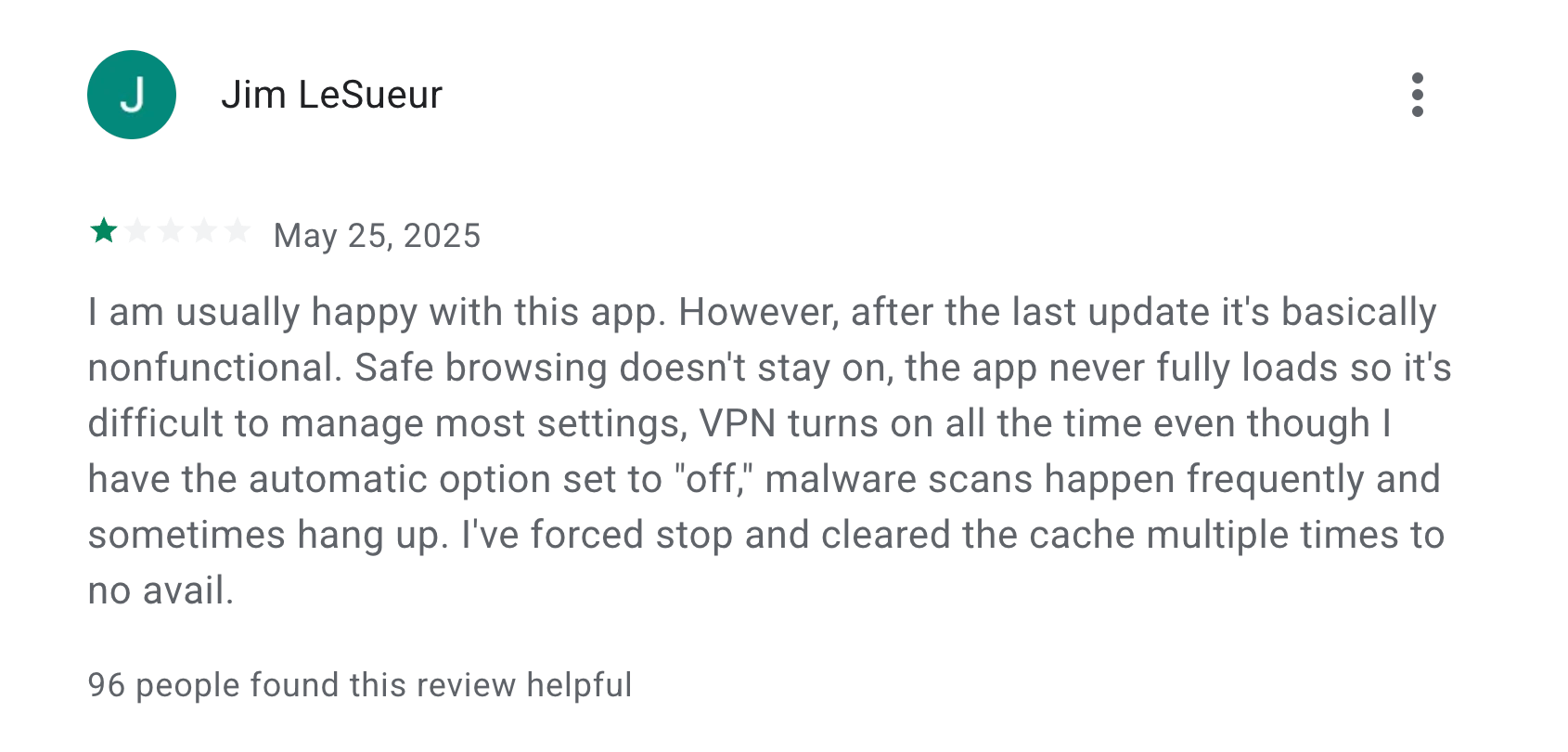
Source: Play Store
How To Cancel Verizon Mobile Protect
You can cancel your Verizon protection plan at any time, and Verizon will issue a prorated refund for the unused portion of your monthly charge. Here are the ways to cancel:
- Through My Verizon: Log in to My Verizon, visit the Products & plan perks page, and manage your device protection from there
- By phone: Contact Verizon customer service directly to process the request
- At a Verizon Store: Visit a local Verizon store and ask a representative to cancel your plan
Verizon Mobile Protect vs. Alternatives
Major phone manufacturers like Apple, Samsung, and Google offer their own insurance plans, while big telcos like T-Mobile and AT&T provide a similar mix of accident protection, extended warranty, and support services for subscribers.
Manufacturer-backed plans often have an advantage in terms of repair quality and customer support because they use official service networks and parts. Carrier plans, however, are more versatile and can cover a wider range of devices.
Here’s a quick overview of some of the most popular alternatives:
- AppleCare+ with Theft and Loss extends the warranty for Apple devices and adds coverage for accidental damage, theft, or loss. Repairs are handled through Apple Stores and authorized providers using official parts and accessories. AppleCare+ typically costs about $9.99–$13.99 per month for a single device, which is generally lower than Verizon.
- T-Mobile Protection 360 combines device insurance with add-ons like unlimited screen protector replacements, McAfee mobile security software, and upgrade options through the JUMP! upgrade program. Pricing varies by your device's tier, ranging from $7 to $25 per month. However, like Mobile Protect, T-Mobile’s plan still focuses primarily on hardware issues and bundled services, offering limited protection against risks like data exposure, malware, and account-level attacks.
- AT&T Protect Advantage combines insurance, extended warranty, and tech support for devices on an AT&T wireless plan. AT&T’s insurance is also administered by Asurion, so you can expect the third-party claim and replacement process to be similar to Verizon’s. Plans range from $16 to $25 per month, with a $50 multi-device plan covering up to four devices. While AT&T doesn’t charge any fees or deductibles for repairs, replacement deductibles can reach up to $400 for flagship phones.
Verdict: Do You Need Verizon Mobile Protect?
At up to $16–$19 per month plus deductibles, the full Mobile Protect bundle is hard to justify for most users. Much of what's included—spam filtering, a VPN, tech support—are features many people won't regularly use. If basic device insurance is all you need, the standalone Wireless Phone Protection plan at $7.95 per month covers that without the extras.
The full plan may make sense if you:
- Have a high-end device and frequently damage or lose phones
- Want unlimited claims with no annual caps
- Prefer not to cover an unexpected repair bill out of pocket
Still, the deeper issue remains that the plan offers no recourse if your personal information is exposed, including cases where the breach originates from Verizon itself. In 2024, the FCC fined Verizon and other major carriers over $200 million for sharing access to customer location data without proper consent. Verizon also suffered a large-scale breach in April 2025 that exposed call records and phone numbers of nearly all Verizon subscribers.
If protecting your data and online exposure matters to you as much as protecting your finances, consider shifting from legacy telecom networks to a privacy-native carrier like Cape.
Cape: The Carrier Built for Security and Privacy
Cape is a privacy-first mobile carrier designed to keep your communications safe from surveillance and misuse. Unlike traditional cell phone plan providers, our business model centers around providing you with premium and secure call, text, and data, rather than harvesting and selling your information.
Our service is built from the ground up with privacy and security at its core, offering unique features like:
Privacy & Security Feature | Description |
Cape doesn’t ask for your name, address, or Social Security number. We only collect the information necessary to provide service, and we retain that information for the minimum amount of time possible. | |
Traditional carriers rely on a fixed International Mobile Subscriber ID (IMSI) to connect your device to cellular networks. This is a vulnerability that lets carriers, advertisers, and bad actors identify and track your device. Cape lets subscribers automatically rotate their IMSI every 24 hours, making it infinitely more difficult to track you or your device. | |
Many services ask for your phone number, but sharing it exposes you to spam, scammers, data brokers, and a variety of other risks. VoIPs, on the other hand, don’t work with 2FA, cost extra, and aren’t encrypted. With Cape, you get two free additional SMS/MMS lines that are middle-to-end encrypted. | |
Most U.S. carriers store your call and text metadata for years, sometimes indefinitely. Cape is built to forget, so call data records (CDRs) are deleted after just 24 hours. | |
Cape nullifies the threat of SIM swapping by completely removing humans from the loop. During signup, you receive a 24-word phrase that generates a private key tied to your number. This effectively means that no one (but you) can move your number to a new carrier or device, not even Cape. | |
Legacy network protocols, like SS7, leave you vulnerable to hackers that can track your location, intercept your calls and texts, and steal sensitive information. Cape’s Network Lock relies on a proprietary signaling proxy to verify that your device’s physical location matches the network it’s trying to attach to. If we detect anything out of the ordinary, Cape automatically blocks the connection, nullifying the potential threat. | |
Traditional voicemail systems are outdated, unencrypted, and another security hole that bad actors can exploit to gain access to your sensitive information. Cape encrypts all voicemails, ensuring only you can access them. | |
While roaming, your phone connects to local telecom providers to enable service. But who knows who might be listening on the other end. Cape provides you with peace of mind by routing your traffic through our U.S.-based mobile core, ensuring your identity, data, and communications remain private and secure. |
Ditch Legacy Carriers: Get Cape Today
Cape is a “Heavy” Mobile Virtual Network Operator (MVNO), meaning we own our mobile core and provision our own SIMs. This gives us full control over how accounts are authenticated and what data is collected (and for how long), and is how we are able to provide privacy and security features no other carrier on the market can offer.
Get started with Cape today and enjoy the peace of mind, knowing you are fully protected against scammers, hackers, bad actors, and other mobile threats.
To help protect more than just your phone, we’ve partnered with Proton. As a new Cape subscriber, you can choose between Proton Unlimited and Proton VPN Plus for just $1 for six months.
Share it