
While AT&T and Verizon continue to control the U.S. telecom market, choosing a mobile carrier in 2026 isn’t as easy as it used to be. For most consumers, the Verizon vs AT&T decision comes down to navigating trade-offs between price and coverage, signal strength and data limits, or convenience and privacy.
Besides regular metrics, you should evaluate how these telco giants deal with increasing data privacy concerns and SIM jacking threats, which have damaged their credibility in the past decade.
In this AT&T vs. Verizon guide, we’ll go over the key parameters of both providers, including coverage, plans, privacy, and security.
Verizon vs. AT&T: Key Points To Compare
Differentiator | AT&T | Verizon |
Coverage |
|
|
Population covered |
|
|
Unlimited plan (before taxes, fees, and add-ons) | Starts at $40/month per line | Starts at $25+/month per line |
Pricing | Affordable unlimited plans with limited features | Higher cost of unlimited plans, but with exclusive offers and freebies |
Hotspot data | Starts at 50 GB | Starts at 30 GB (available on Plus plans and up) |
Download speed | Up to 5,000 Mbps (fiber) No verifiable data for LTE upper limit | Up to 2,300 Mbps (fiber) Up to 75 Mbps (LTE mobile) |
Streaming benefits | None (AT&T has phased out its Max perks) | Ad-free:
With ads:
|
Support options |
|
|
Security features | Paid add-on:
Included in unlimited plans:
| Paid add-ons:
Included in unlimited plans:
|
*Plan data is subject to change. Availability of some features and offers may also differ depending on the selected plan or location.
With flexible unlimited plans, leading 5G speeds, and nationwide 4G LTE coverage, Verizon remains one of the top wireless network operators. Its consistent performance makes it an optimal choice for consumers who prioritize dependability, especially in rural locations.
AT&T, on the other hand, offers a broader low-band 5G coverage than most providers, available in more than 22,000 cities and towns. Affordable family plans and generous mobile hotspot data are some of the perks that place it among the “big three” mobile providers.
So, is Verizon or AT&T better?
While both options are popular, you should evaluate four key criteria to see which mobile carrier is better for you:
- Coverage
- Plans and pricing
- Customer service
- Privacy and security
1. AT&T vs. Verizon: Coverage
AT&T and Verizon offer decent 4G and 5G coverage, but the quality you get can differ based on factors like your location and city density, as well as the provider’s 5G rollout strategy.
When it comes to 5G coverage, AT&T has a slight upper hand over Verizon, providing over 315 million users with low-band 5G. The catch with low-band 5G is that speeds are closer to the 4G range, which may be an issue for consumers who value speed over coverage. While it favors everyday users, low-band 5G may not be optimal for downloading large files, video streaming, or gaming.
Here’s a complete list of AT&T’s 5G service options:
- 5G (Low-Band): Operating on 850 MHz spectrum, it relies on range and coverage while offering modest speeds comparable to 4G LTE.
- 5G+ (Mid-Band): It uses AT&T’s mid-band and mmWave network, striking a balance between wide coverage and speed.
- 5G Evolution (5GE): Often described as an improved version of 4G LTE, 5GE is a robust solution for high-demand urban areas.
While AT&T may be better than Verizon in terms of 5G availability, Verizon strives for quality over quantity. In the RootMetrics State of the Mobile Union Report for the second half of 2024, Verizon’s 5G network was recognized as the best, fastest, and most reliable. Verizon introduced the 5G Ultra Wideband network as an ideal solution for power users, built for large downloads, file sharing, and low-latency video streaming, although it’s not as widely available as AT&T’s 5G.
Verizon also has better coverage for 4G LTE, which makes it a more dependable choice for consumers living in remote areas or those frequently on the go. Here’s what one customer had to say:
To compare coverage side-by-side, check out the AT&T vs Verizon coverage map below:
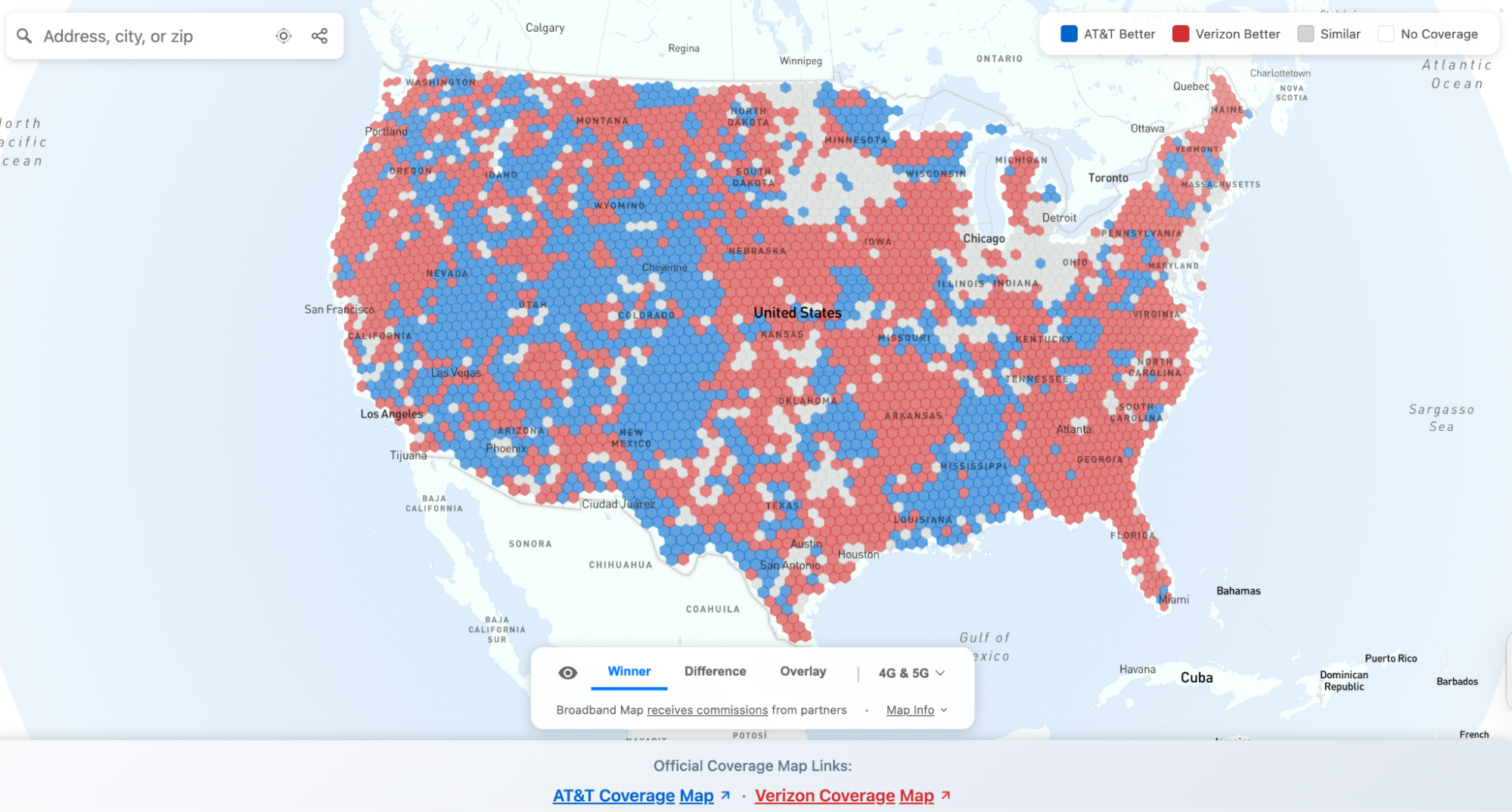
Source: Broadbandmap
2. AT&T vs. Verizon: Plans and Pricing
Though their coverage and network performance may be considered similar in some locations, the plan structure is what sets them apart. When weighing AT&T or Verizon pricing, we’ve noticed they differ in priorities: AT&T offers unlimited plans that won’t break the bank, while Verizon prioritizes consumers who prefer perks and extras in their bundles.
AT&T Pricing
AT&T offers numerous unlimited plans at affordable rates, prioritizing unlimited calls and texting from the U.S. to more than 200 countries. The table below outlines AT&T’s top tier 5G plans:
Plan | Description | Additional Features | Monthly Price* |
AT&T Elite 2.0SM |
|
| $70/line |
AT&T Premium 2.0SM |
|
| $50/line |
AT&T Extra 2.0SM |
|
| $40/line |
*Baseline prices for four lines. You are allowed five lines per plan and can avail of a discount on the fifth one.
Verizon Pricing
Verizon, on the other hand, offers bundles packed with additional perks and streaming services, providing a more comprehensive experience. Find the most popular 5G Verizon plans in the table below:
Plan | Description | Additional Features | Monthly Price* |
Unlimited Ultimate |
|
| $55/line |
Unlimited Plus |
|
| $40/line |
Unlimited Welcome |
|
| $25+/line** |
*Baseline prices for four lines. You can opt for up to 12 lines for a specific plan for adjusted pricing.
**Cheaper rates are available on 4+ lines only. Other rates include 1 line for $65/line, 2 lines for $55/line, and 3 lines for $40/line.
You can also build your plan from scratch by choosing from Unlimited plans and adding desired perks for a $10–$15 monthly fee. While this option is available to new consumers, you can upgrade to a tailored Unlimited plan as an existing myPlan user.
3. AT&T vs. Verizon: Customer Service
Both AT&T and Verizon offer a robust customer support system across multiple channels, but their efficacy may vary depending on the requested service.
The AT&T GuaranteeSM program protects consumers in case of a network interruption, offering instant resolution by providing credit for the entire day of service. With MyAT&T, you can pay bills, manage accounts, and access customer support directly in the app. However, many reviews cite issues such as long wait times, inconsistent information provided by representatives, and the time-consuming process of proving that the cancellation wasn’t authorized.
My Verizon app is an all-in-one hub for managing your account and payments, switching plans, and getting help via the voice-enabled Verizon Assistant. In addition to the app, Verizon chat and social response teams on Facebook Messenger seem to be the preferred sources of information. Despite multiple channels of communication and 24/7 customer support, there are many customer complaints regarding hidden fees, lack of transparency in pricing, and extended response times.
4. AT&T vs. Verizon: Privacy Risks and Security
For privacy-conscious consumers, this is where the Verizon vs. AT&T comparison gets most important. While both carriers offer industry-standard security features to protect customers, their approaches tend to center around fraud prevention and overall user experience, rather than data security.
AT&T’s first line of defense when it comes to user security is ActiveArmor, a proactive app that allows you to:
- Customize call controls to block fraudsters
- Block scam texts and harmful websites
- Upgrade to ActiveArmor Advanced Mobile Security with public Wi-Fi protection, Identity Monitoring, and Caller ID
Verizon relies on an interconnected system of protective mechanisms, including:
- Identity Secure and Digital Secure for enhanced security online
- Call Filter app for filtering calls and auto-blocking spam
- Two-factor authentication for an added security step
- SIM Protection and Number Lock to curb SIM swap
While both carriers strive to protect consumers from online threats, it’s difficult to say whether Verizon is more secure than AT&T or whether AT&T is safer than Verizon because neither shields their subscribers’ personal information effectively.
In 2024 alone, AT&T experienced two major data breaches affecting millions of consumers. The first breach occurred in March and compromised the sensitive information of over 70 million people, exposing valuable data like Social Security numbers. Only a month following the first incident, another breach revealed cell site identification and phone numbers.
Unfortunately, Verizon isn’t far behind when it comes to privacy risks. According to Cape’s Telco Data Breach Timeline, Verizon has experienced several security incidents in recent years. These include SIM swapping activities, cybersecurity attacks, and internal data breaches.
For instance, a Verizon employee was found leaking the personal information of more than 63,000 people in 2024. In a more recent security incident, the very system designed to protect the subscribers—Verizon Call Filter iOS app—became a vulnerability. A security researcher, Evan Connelly, detected a significant flaw in the app, which allowed intruders to access call data, including detailed incoming call records, for any Verizon number.
Despite the alarming trends in data security, the industry has failed to make any meaningful progress. Verizon’s 2025 Data Breach Investigations Report (DBIR), an analysis of industry trends based on investigations and contributions from partners, shows that system intrusion breaches have doubled compared to 2024.
Is Verizon or AT&T Better?
AT&T and Verizon offer near-interchangeable services in many aspects, so the choice boils down to your priorities. The general trend suggests that AT&T is the more competitive option with straightforward plans and widespread standard 5G coverage, while power users will appreciate Verizon’s superior 5G Ultra Wideband service and customization options.
When it comes to which carrier is better for privacy—neither AT&T nor Verizon stands out as a clear winner. The problem is that both brands have suffered significant trust erosion in the past couple of years. While AT&T has faced more high-profile data breaches in recent years, Verizon isn’t far behind.
Let’s consider superficial security measures. For instance—both providers focus only on generic fraud prevention and overlook the vulnerabilities around sensitive user data exposed to third parties. Their credibility has further weakened after both AT&T and Verizon were fined $47m and $80m by the FCC in 2024 for selling real-time location data to data aggregators, which allowed malicious actors to locate potential targets with precision.
Multiple data leaks and breaches over the years reveal a singular pattern: Both AT&T and Verizon collect vast customer data without offering consumers effective safeguards or controls, which attracts espionage-motivated attacks.
Luckily, there is a straightforward solution. If you want more control over your data privacy and security without compromising coverage and speeds, or you want to switch carriers because of recent data breaches, consider Cape—America’s leading privacy-first mobile carrier.
Cape: Privacy Hand-in-Hand With Nationwide Connectivity
The weakest point in the security systems of major mobile carriers is the amount of data they access and collect—and unfortunately, often leak or sell.
Cape is a privacy-first mobile carrier that doesn’t demand blind faith from subscribers and collects only the minimum amount of data required to provide its service.
Cape is designed to provide an accessible and easy-to-manage service on par with all premium mobile carriers. Cape provides:
- Nationwide coverage
- Fast 4G and 5G speeds
- Industry-leading network density
- eSIM support (bring your own device)
- Live 24-hour support (chat with real people in minutes)
What sets Cape apart is that it’s built to forget. With traditional cellular networks, collecting and retaining personal information, such as payment details, location data, and call logs, is a given. They rely on legacy infrastructure, outdated security protocols, and a business model centered around profiting off your personal data.
Cape, on the other hand, follows a minimal-trust model. It can never monetize or lose your sensitive information because it isn’t collected or stored in the first place. Cape leaves legacy tech behind, operating its own cloud-based mobile core. This gives Cape unique control over the implementation of security protocols, workflow encryption, and how data is (or is not) collected and stored.
Other security and privacy features of Cape include:
Feature | Description |
Many services ask for your phone number, but sharing it exposes you to spam, scammers, data brokers, and a variety of other risks. VoIPs, on the other hand, don’t work with 2FA, cost extra, and aren’t encrypted. Cape gives you two free SMS/MMS lines that are end-to-end encrypted. You can reserve your primary number for communicating with your close friends and family, and use Secondary Numbers for anything from shopping and signing up for discounts, to receiving secure OTPs. | |
Cape nullifies the threat of SIM swapping by completely removing humans from the loop. During signup, you receive a 24-word phrase that generates a private key tied to your number. Only you, not even Cape, can move your number to a new device or carrier. | |
Traditional voicemail systems are outdated, unencrypted, and another security hole bad actors can exploit to gain access to your sensitive information. Cape encrypts all voicemails, ensuring only you can access them. | |
While roaming, your phone connects to local telecom providers to enable service that’s prone to interception. Cape provides you with peace of mind by routing your traffic through our U.S.-based mobile core to keep your identity and communications private. | |
Traditional carriers use a fixed International Mobile Subscriber ID (IMSI), making your device trackable. Cape automatically rotates your IMSI every 24 hours, which makes tracking a lot more harder. | |
Most U.S. carriers store your call and text metadata for years, sometimes indefinitely. Cape is built to forget, so call data records (CDRs) are deleted after just 24 hours. | |
Legacy protocols like SS7 enable tracking and interception. Cape verifies your device’s physical location before network attachment and automatically blocks suspicious connections. |
Ditch Legacy Carriers: Get Cape Today
Cape is a “Heavy” Mobile Virtual Network Operator (MVNO), meaning we own our mobile core and provision our own SIMs. This gives us full control over how accounts are authenticated and what data is collected (and for how long), and is how we are able to provide privacy and security features no other carrier on the market can offer.
Get started with Cape today and enjoy the peace of mind, knowing you are fully protected against scammers, hackers, bad actors, and other mobile threats.
To help protect more than just your phone, we’ve partnered with Proton. As a new Cape subscriber, you can choose between Proton Unlimited and Proton VPN Plus for just $1 for six months.
Share it