Your phone number is used across account signups, subscriptions, verification, and everyday communication. Over time, it gets associated with multiple services, platforms, and databases, and you don’t have much control over how your number is shared or used.
Using a secondary phone number is one way to manage this overexposure and keep your personal number private. It’s more than just an alternate line; it helps separate communication across work, shopping, online activity, or situations where you don’t want to share your permanent number.
This guide breaks down what a secondary number is, where it’s useful, and how to get one. We’ll help you compare some top options, from convenient apps to carrier-offered services, so you can choose the right setup.
What Is a Secondary Phone Number?
A secondary phone number is an additional phone line you can use in addition to your primary number, often on the same device. It works like any regular number, so you can call, text, and even receive verification codes, but it exists and operates independently of your main number.
The most common use case of a secondary number is to have a decoy number for low-trust interactions. Using a single phone number across accounts and services means they inevitably get linked to your personal identity. Also, each time you share your number with a service or unfamiliar contact, you increase the risk of spam, unwanted outreach, targeted smishing and vishing attacks, and in worst cases, SIM swap attacks.
Once you have one or more secondary numbers, you can keep your primary line reserved for friends and family. This separation helps you:
- Keep your primary number off third-party databases and trackers
- Direct spam calls and texts to the alternate number instead of your main line
- Reduce the risk of your primary number getting exposed in breaches (lower risk of account takeovers linked to password resets and verification codes)
Where Can You Use a Secondary Number?
Below are everyday scenarios where having a separate number makes communication safer and more organized:
- Online transactions and registrations: Use a secondary number for signups, purchases, and forms so your main number isn’t tied to marketing lists or exposed during potential data breaches.
- Classifieds and marketplaces: When selling items or responding to ads, a secondary number keeps interested buyers from getting your personal contact information while still allowing legitimate communication.
- Dating, travel, and social connections: Share a secondary number with new contacts and only give out your real number once trust is established.
- Work vs. personal separation: Freelancers, employees, and entrepreneurs can use a secondary number for client or vendor communication, making it easier to manage availability and boundaries.
- Authentication and security codes: Assign lower-risk two-factor authentication (2FA) or verification flows to a secondary line so you don’t rely on your main one for every login or account recovery.
- Temporary or one-off use: Share a secondary number for short-term projects, events, or limited interactions, so you can stay reachable without ongoing contact.
Mind that not every secondary number service offers the same level of privacy or usability. Some providers may still collect, retail, and share your number and activity to third parties, which can undermine your privacy, while other services may come with trade-offs in compatibility or convenience. That’s why how you choose your secondary line matters.
How To Get a Secondary Phone Number [With Service Examples]
There are three primary ways to get a secondary phone number. Each differs in how the service is provisioned, how convenient or reliable it is, and how much control you have over your data. The options to obtain one are:
- Voice over Internet Protocol (VoIP) apps
- Burner prepaid SIM
- eSIM-based secondary numbers
1. Voice Over Internet Protocol (VoIP) Apps
VoIP apps provide phone numbers that run over the internet instead of using a cellular network. Many of these apps also provide limited messaging features.
With a VoIP number, you typically sign up in an app, pick a number from available area codes, and start using it right away. Everything is managed through a smartphone app or online dashboard.
Some of the popular secondary phone number apps are:
VoIP Platform | Key Features |
Google Voice | Free personal numbers for domestic calling and texting in the U.S. and Canada; business plans include auto-attendants, desk phone support, international coverage, and call recording |
TextNow | Free (but ad-supported) second number with unlimited calls/texts over Wi-Fi or data |
Quo (formerly OpenPhone) | Professional secondary number with business messaging, cross-device sync, and organized contact history |
Hushed | 300+ area codes (40+ countries), call forwarding, custom voicemail, crypto payments |
While many of these services offer enterprise-oriented features like voicemail transcription, auto-attendants, and call forwarding, there are some glaring limitations of VoIP apps that really impact usability:
- Banks, social media, and other major services frequently block VoIP numbers for critical SMS alerts like 2FA or OTPs
- VoIP numbers generally offer limited to no encryption, so your calls and texts might be visible to intermediary networks or vulnerable to interception by attackers
- VoIP numbers are dependent on internet connectivity
2. Burner Prepaid SIM
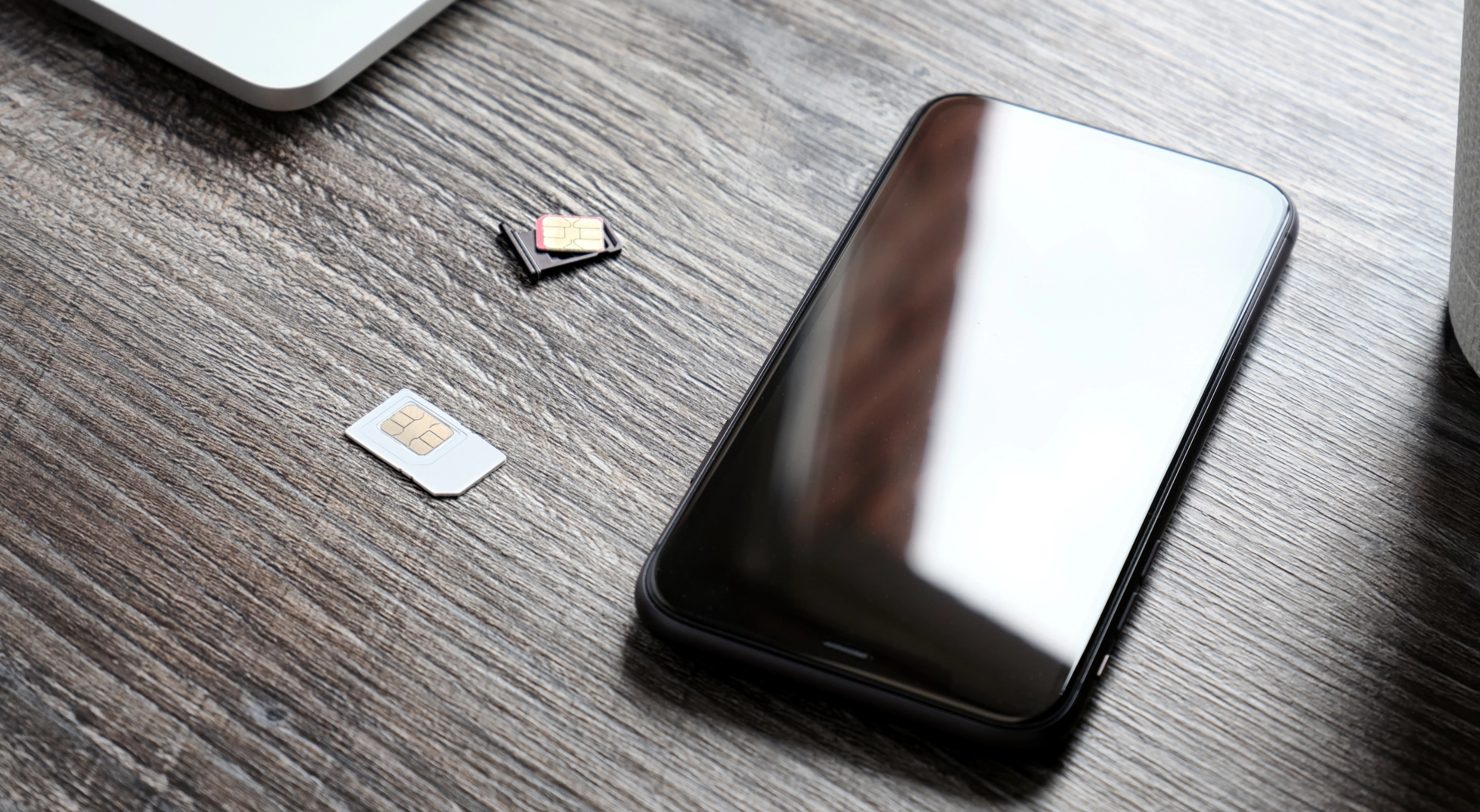
If you want the functionality of a regular cellular connection, a burner SIM card from a mobile carrier is a more reliable way to get a secondary number. You can insert the SIM in a dual-SIM device, an old phone you already have, or a cheap feature phone you purchase as a “burner” device.
You can find prepaid SIMs with most traditional carriers, including AT&T, Verizon, and T-Mobile.
Because a burner SIM is a real carrier line, it addresses the core limitations of VoIP numbers regarding internet dependency and SMS compatibility. You can also use it reliably for:
- SMS-based authentication, mobile banking, and email logins
- Travel scenarios where network stability matters
- Long-term business use
That said, the reliability of a burner SIM comes with its own trade-offs.
Unlike VoIP app solutions, prepaid SIMs require compatible hardware and can be harder to manage at scale. It’s also tied to identity verification requirements, which beats the purpose if you’re looking for a more anonymous mode to communicate.
More critically, the privacy and security of your secondary burner number remain dependent on the carrier’s data handling policies, most of which are known to collect, retain, and share customer data as part of their business practices. In 2024 itself, the FCC fined major U.S. carriers $200 million for illegally sharing customer location information with third-party firms, which makes their prepaid SIMs less ideal for business or sensitive use.
Also, replacing or recycling through prepaid SIMs isn’t always seamless. Rotating SIMs means repeating the identity verification and activation processes, so it’s not quite convenient or anonymous.
3. eSIM-Based Secondary Numbers
If you want the reliability of a real number without the security issues of big telcos, eSIM-based secondary numbers—particularly from privacy-first providers like Cape—are a more convenient solution. eSIM-based secondary numbers allow you to add a secondary line digitally on the same device (or a different one if you prefer), without needing a physical SIM card.
You can activate eSIMs in minutes and use them alongside your primary line. For most users, it’s a seamless way to maintain number separation.
However, the eSIM ecosystem in the U.S. is fragmented, so it’s important you choose your provider carefully. Many consumer-facing eSIM offerings today are travel-focused with limited usability and long-term support.
Cape, a modern, privacy-focused carrier, offers a more straightforward way to create eSIM-based secondary mobile numbers that work with verification codes and offer encryption-based security:
Cape’s Advantage | Explanation |
Multiple carrier numbers included | You get two free secondary numbers per plan that work alongside your primary Cape line. |
Cape secures your texts with middle-to-end encryption, protecting them from network interception or base station exploits. This is a level of security that traditional carriers and eSIM providers don’t offer. | |
Privacy-first by design | Cape operates on a minimal-trust, minimal-data model. The data you don’t share cannot be compromised. |
SIM swap resistance | A 24-word recovery phrase secures your account instead of passwords. So, only you can transfer your number, preventing most SIM swap attacks driven by insider threats or social engineering. |
Getting started with Secondary Numbers as a Cape subscriber is simple:
- Open the Cape app and navigate to your Account settings
- Locate Experimental Features and select Secondary Numbers
- Follow the in-app steps to opt in and activate your additional numbers
Secondary Phone Number for Business: What To Choose
Choosing a secondary phone number for business use depends on what you prioritize: convenience, compatibility, or long-term privacy.
A VoIP secondary number app can be an easy and flexible option if you need a free/low-cost disposable line for short-term use. But they may not be best for sensitive business use as they often fail for critical functions like 2FA and don’t provide meaningful protection against interception or data leaks.
A prepaid SIM card provides full cellular functionality and supports 2FA verification, but has the same security limitations for sensitive use cases. Most carriers still collect your location, usage data, and purchase details.
Cape’s eSIM-based secondary numbers are best for individuals and businesses that prioritize secure communications. Cape offers enhanced protection against legacy network-level threats for all your primary and secondary numbers, so you can apply your numbers as you like. Here’s a sample setup:
- Primary Cape number: Reserved for trusted contacts and calling
- Secondary number A: Messaging for customers, vendors, and signups
- Secondary number B: Security-critical use cases like 2FA authentication
Cape: The Carrier Built for Security and Privacy
Cape is a privacy-first mobile carrier designed to keep your communications safe from surveillance and misuse. Unlike traditional cell phone plan providers, our business model centers around providing you with premium and secure call, text, and data, rather than harvesting and selling your information.
Our service is built from the ground up with privacy and security at its core, offering unique features like:
Privacy & Security Feature | Description |
Cape doesn’t ask for your name, address, or Social Security number. We only collect the information necessary to provide service, and we retain that information for the minimum amount of time possible. | |
Traditional carriers rely on a fixed International Mobile Subscriber ID (IMSI) to connect your device to cellular networks. This is a vulnerability that lets carriers, advertisers, and bad actors identify and track your device. Cape lets subscribers automatically rotate their IMSI every 24 hours, making it infinitely more difficult to track you or your device. | |
Many services ask for your phone number, but sharing it exposes you to spam, scammers, data brokers, and a variety of other risks. VoIPs, on the other hand, don’t work with 2FA, cost extra, and aren’t encrypted. With Cape, you get two free additional SMS/MMS lines that are middle-to-end encrypted. | |
Most U.S. carriers store your call and text metadata for years, sometimes indefinitely. Cape is built to forget, so call data records (CDRs) are deleted after just 24 hours. | |
Cape nullifies the threat of SIM swapping by completely removing humans from the loop. During signup, you receive a 24-word phrase that generates a private key tied to your number. This effectively means that no one (but you) can move your number to a new carrier or device, not even Cape. | |
Legacy network protocols, like SS7, leave you vulnerable to hackers that can track your location, intercept your calls and texts, and steal sensitive information. Cape’s Network Lock relies on a proprietary signaling proxy to verify that your device’s physical location matches the network it’s trying to attach to. If we detect anything out of the ordinary, Cape automatically blocks the connection, nullifying the potential threat. | |
Traditional voicemail systems are outdated, unencrypted, and another security hole bad actors can exploit to gain access to your sensitive information. Cape encrypts all voicemails, ensuring only you can access them. | |
While roaming, your phone connects to local telecom providers to enable service. But, who knows who might be listening on the other end. Cape provides you with peace of mind by routing your traffic through our U.S.-based mobile core, ensuring your identity, data, and communications remain private and secure. |
Ditch Legacy Carriers: Get Cape Today
Cape is a “Heavy” Mobile Virtual Network Operator (MVNO), meaning we own our mobile core and provision our own SIMs. This gives us full control over how accounts are authenticated and what data is collected (and for how long), and is how we are able to provide privacy and security features no other carrier on the market can offer.
Get started with Cape today and enjoy the peace of mind, knowing you are fully protected against scammers, hackers, bad actors, and other mobile threats.
To help protect more than just your phone, we’ve partnered with Proton. As a new Cape subscriber, you can choose between Proton Unlimited and Proton VPN Plus for just $1 for six months.
Share it