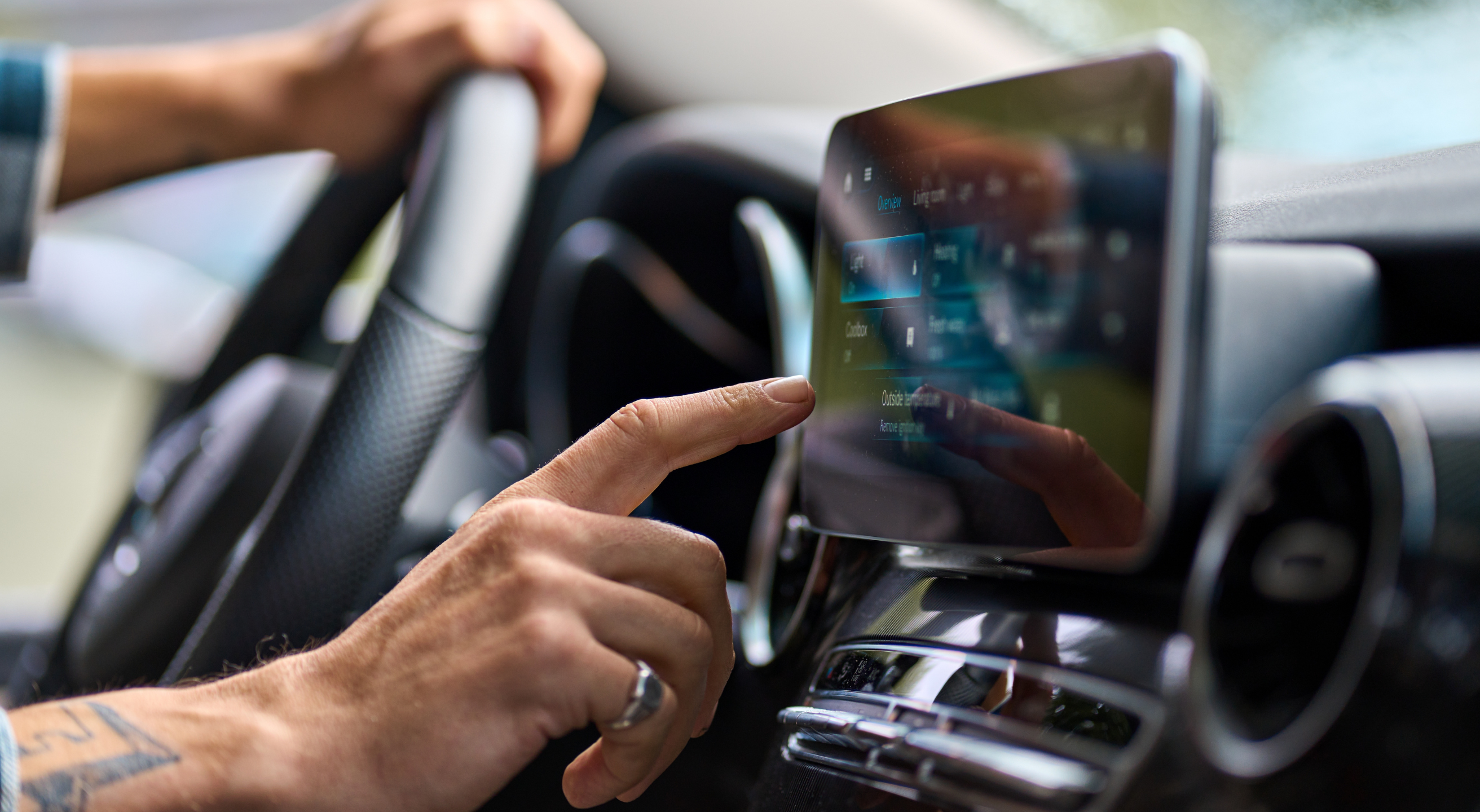
Having a car that updates itself, tracks its own health, and optimizes routes can redefine the driving experience, but it also transforms your vehicle into a data machine. Connected cars collect location data, driving patterns, and even in-car interactions to power and enhance advanced features.
With such sensitive data stored in your vehicle, cybersecurity becomes non-negotiable. In this guide, you’ll learn about the types of data collected, the risks associated with connectivity, and practical steps you can take to enhance connected car security.
What Is a Connected Car?
A connected car is a vehicle with internet access and integrated sensors that enable it to communicate with external networks. To establish connection, these vehicles use built-in cellular modems, Wi-Fi, Bluetooth, or specialized V2X (Vehicle-to-Everything) technology.
Once connected, the car begins sharing data with apps, cloud services, and other systems to support features such as:
- Real-time navigation
- Predictive maintenance alerts
- Remote start, lock, and unlock functions
- Software updates
- Live safety alerts from nearby vehicles and infrastructure (V2X)
- Find-my-car and stolen vehicle tracking
- In-car services that automatically personalize apps, music, and settings
These features aren’t reserved just for electric or high-end vehicles. Many modern cars incorporate connectivity. It is projected that there will be over 640 million connected cars worldwide by 2027, making them the future of driving.
While the perks of smart vehicles are compelling, connected cars also introduce a growing number of security and privacy risks we shouldn’t ignore, starting from the volume and breadth of personal data they collect.
Connected Car Data Privacy Issues: What Type of Data Is Collected?
Connected cars gather different types of information about you, your vehicle, and your driving habits, including:
Type of Data | Examples |
Personal data |
|
Biometric data |
|
Vehicle telemetry |
|
Location |
|
Driving behaviour |
|
In-car use of devices |
|
Once collected, this data can be accessed and used by different parties. Automakers use it to optimize your car's performance, push maintenance alerts, or improve safety features. Insurers can also use it to evaluate your driving behaviour for insurance programs, while app providers may leverage that data for outreach or analysis.
Why Connected Car Data Security Matters
With every piece of data connected cars collect, you leave a digital trail of your personal data, habits, and location, which isn’t always under your control. Many drivers and vehicle owners aren’t aware of how much of their private information is being recorded, often without their clear consent.
This matters because a gap in security can expose that data to hackers and unauthorized third parties, triggering serious implications for both personal safety and data privacy. For instance, drivers can become targets of identity theft, financial fraud, or targeted attacks.
Connected Cars Security Risks
Every Internet of Things (IoT) device comes with inherent vulnerabilities, and connected cars are no different. By connecting to the internet, a vehicle creates multiple entry points where unauthorized actors can gain access. This raises multiple concerns, and becoming aware of them is the foundational step toward protecting your data.
Here are the main connected car security issues:
- Unauthorized remote access (hacking): Since connected cars are networked devices, attackers can target their communication channels, including cellular, Bluetooth, and Wi-Fi, and gain access to telemetry or even control systems.
- Data interception or theft: Without secure transmission like encryption, data shared between the car, cloud servers, and phone apps can be intercepted and expose location or personal information.
- Excessive data collection: Many connected-car systems collect more information than they actually need. For example, some manufacturers may continuously gather data from embedded cameras within the car, which can be a massive invasion of privacy.
- Indefinite or inappropriate retention of data: Your data can be stored by several parties, from car manufacturers to cloud providers. The problem is that they can store and use this data long-term, with associated risks of data breaches or misuse.
- Functionality risks: Connectivity also carries the potential for bugs, network failures, or cyberattacks that can disrupt some essential car functions (like starting or controlling your car) and jeopardize your safety.
How Connected Cars Security Works
To counter these risks, most connected cars come equipped with built-in security features. Here are some of the key components that manufacturers rely on to enhance security:
Security Measure | How It Works |
Secure telematics gateway | Data transmitted between the car and the external servers is encrypted, and the telematics gateways monitor and filter network traffic to prevent unauthorized access. |
Network segmentation | The main vehicle systems (like brakes and steering) are separated from infotainment and external communication networks. So, if hackers compromise the entertainment system, they won’t be able to reach the endpoints critical for the driver’s safety. |
Secure over-the-air (OTA) updates and authentication | Cars and their software modules receive updates via authenticated, secure mechanisms to prevent attackers from injecting malware under the guise of real updates. |
Privacy and data-minimization practices | The design of connected cars can follow the data protection by design and by default principle issued by the European Data Protection Supervisor (EDPS). This means that it connects only necessary data, gives users control over what is shared, and limits retention. |
With the increasing number of connected cars, countries across the globe no longer rely solely on manufacturers’ goodwill to implement these security measures. Instead, they are introducing specific safety and privacy regulations.
For example, Europe has introduced regulations such as UNECE R155 and R156 to mandate cybersecurity measures and software update management for connected cars. In addition, GDPR and the upcoming Cyber Resilience Act set rules for personal data and stricter security expectations.
As of March 17, 2025, the U.S. Department of Commerce enforces the Connected Vehicle Rule, which prohibits the use of hardware and software from China and Russia and builds on existing safety standards (FMVSS) and voluntary cybersecurity frameworks such as ISO/SAE 21434.
A key compliance milestone took effect on March 17, 2026: the rule's software prohibitions now apply to model-year 2027 connected vehicles, and any legacy code from covered entities can no longer be maintained or updated by those entities.
The issue is that not all threats are addressed through these regulations, and manufacturers may still not adopt the necessary security measures. On the positive side, you can take your security into your own hands by making certain proactive steps.
How To Protect Your Connected Car From Attacks: 7 Recommended Practices
If you own or plan to get a connected car, you can take active steps to improve your security and privacy. Here are some of the best practices that can help you protect your data:
- Install updates regularly
- Cut off unnecessary connectivity
- Use strong passwords and multi-factor authentication (MFA)
- Audit your connected devices
- Stay cautious with third-party apps and devices
- Monitor unusual behavior
- Be selective with optional features
1. Install Updates Regularly
Whenever your car manufacturer or service provider issues a software update and prompts you to install it, do it as soon as you can. These updates, whether they are for car firmware or related mobile apps, can patch known vulnerabilities.
2. Cut Off Unnecessary Connectivity
Turn off Wi-Fi, Bluetooth, or cellular activity when you’re not using connected services. If your car supports enabling airplane mode or disabling remote features, you can also opt for one of those options when you don’t need connectivity.
3. Use Strong Passwords and MFA
Use unique, complex passwords for vehicle-related apps and accounts, and avoid using credentials from other services. Reused passwords increase the risk that a single breach can compromise multiple systems.
When available, enable MFA or biometric logins, which add an extra layer of protection by requiring verification beyond a password alone.
4. Audit Your Connected Devices
Check which devices are connected to your car, which apps have permissions, and whether any old accounts or devices are still authorized.
Regularly reviewing and removing unnecessary access can help reduce security risks. This step is especially important before selling or re-leasing the vehicle.
5. Stay Cautious With Third-Party Apps and Devices
Avoid plugging in aftermarket dongles (such as OBD‑II Wi-Fi or telemetry dongles) unless absolutely necessary, as these apps and devices can introduce vulnerabilities. Instead, use apps and accessories only from trusted sources.
6. Monitor Unusual Behavior
Unusual activity, such as unexpected remote unlocks or battery drain, may indicate a security compromise. If this occurs, disconnect the vehicle from the internet, change all related passwords, and contact the manufacturer for assistance.
7. Be Selective With Optional Features
Just because a service is available or you are prompted to use it doesn’t mean that you have to enable it. Consider whether features such as remote diagnostics or infotainment sharing provide meaningful value, and opt out of those you don’t actually need.
Enhancing Data Privacy Beyond Connected Car Cybersecurity
Safeguarding data privacy extends beyond connected car cybersecurity. Adopting broader practices to address your overall digital footprint can provide more comprehensive protection and lay the foundation for a safer connected experience across all your devices.
The following measures offer simple, effective ways to improve your overall digital security:
- Use a virtual private network (VPN): If you connect your phone or laptop to an external Wi-Fi network, a VPN can mask your data and location. You can also use a VPN in a connected car to secure its Wi-Fi. To set it up, install a VPN app on your phone and then connect the vehicle to your phone’s hotspot.
- Don’t install unauthorized apps or services: When downloading apps, use the app store or official websites. Third-party or pirated apps can contain malware or spyware that compromise your phone, car, or other devices.
- Review privacy policies and settings: Take time to read privacy policies before agreeing to them, as they explain what data is collected and how it’s used. You can also review your phone’s settings and disable any permissions that are unnecessary or unwanted.
- Limit sharing personal data: Be intentional about the data you share online or with apps. Whenever possible, turn off location tracking, analytics, or advertising permissions.
- Use a privacy-first mobile carrier: If your car relies on your phone’s internet, you might already be sharing more data than you intend to. Traditional carriers are prone to interception and also track metadata such as location and network usage that put you at risk. You can cut the data sharing at the core by using a privacy-first mobile carrier like Cape. Unlike traditional carriers, Cape collects minimal data, relies on secure authentication, and implements modern security protocols to keep your data safe and private.
Cape: The Carrier Built for Security and Privacy
Cape is a privacy-first mobile carrier designed to keep your communications safe from surveillance and misuse. Unlike traditional cell phone plan providers, our business model centers around providing you with premium and secure call, text, and data, rather than harvesting and selling your information.
Our service is built from the ground up with privacy and security at its core, offering unique features like:
Privacy & Security Feature | Description |
Cape doesn’t ask for your name, address, or Social Security number. We only collect the information necessary to provide service, and we retain that information for the minimum amount of time possible. | |
Traditional carriers rely on a fixed International Mobile Subscriber ID (IMSI) to connect your device to cellular networks. This is a vulnerability that lets carriers, advertisers, and bad actors identify and track your device. Cape lets subscribers automatically rotate their IMSI every 24 hours, making it infinitely more difficult to track you or your device. | |
Many services ask for your phone number, but sharing it exposes you to spam, scammers, data brokers, and a variety of other risks. VoIPs, on the other hand, don’t work with 2FA, cost extra, and aren’t encrypted. With Cape, you get two free additional SMS/MMS lines that are middle-to-end encrypted. | |
Most U.S. carriers store your call and text metadata for years, sometimes indefinitely. Cape is built to forget, so call data records (CDRs) are deleted after just 24 hours. | |
One-time passwords (OTP) can be intercepted by bad actors if SMS messages aren’t encrypted, exposing your bank accounts and other sensitive data. With Cape, you can encrypt and route all SMS/MMS messages through the Cape app, so even if they’re intercepted, nobody can read them. This feature is currently only available on iPhone. Android coming soon. | |
Cape nullifies the threat of SIM swapping by completely removing humans from the loop. During signup, you receive a 24-word phrase that generates a private key tied to your number. This effectively means that no one (but you) can move your number to a new carrier or device, not even Cape. | |
Legacy network protocols, like SS7, leave you vulnerable to hackers that can track your location, intercept your calls and texts, and steal sensitive information. Cape’s Network Lock relies on a proprietary signaling proxy to verify that your device’s physical location matches the network it’s trying to attach to. If we detect anything out of the ordinary, Cape automatically blocks the connection, nullifying the potential threat. | |
We don’t require your name or billing address. Payments are processed by Stripe and tokenized, so your subscription can’t be tied back to your personal details. | |
Traditional voicemail systems are outdated, unencrypted, and another security hole bad actors can exploit to gain access to your sensitive information. Cape encrypts all voicemails, ensuring only you can access them. | |
While roaming, your phone connects to local telecom providers to enable service. But, who knows who might be listening on the other end. Cape provides you with peace of mind by routing your traffic through our U.S.-based mobile core, ensuring your identity, data, and communications remain private and secure. |
Ditch Legacy Carriers: Get Cape Today
Cape is a “Heavy” Mobile Virtual Network Operator (MVNO), meaning we own our mobile core and provision our own SIMs. This gives us full control over how accounts are authenticated and what data is collected (and for how long), and is how we are able to provide privacy and security features no other carrier on the market can offer.
Get started with Cape today and enjoy the peace of mind, knowing you are fully protected against scammers, hackers, bad actors, and other mobile threats.
To help protect more than just your phone, we’ve partnered with Proton. As a new Cape subscriber, you can choose between Proton Unlimited and Proton VPN Plus for just $1 for six months.
FAQs
Can I really opt out of my connected car's data collection?
Does my car insurance company really track my driving?
What about my phone data when I connect to CarPlay or Android Auto?
Share it