
Helium Mobile started off 2026 by discontinuing its $5 Beta and $20 Unlimited plans, then further restructured its lineup in April 2026 by retiring the Zero free plan it had introduced just three months earlier. Helium now offers only the $15 Air and $30 Infinity plans, with “affordable connectivity” still positioned as the main selling point, though the company's repeated pricing changes have eroded customer trust.
With this change, the company introduced a free plan and is still emphasizing “affordable connectivity” as the main selling point. But is that really true in practice or just a marketing strategy to try and attract new users?
In this comprehensive Helium Mobile review, we’ll take a closer look at the carrier’s plans and features, so you can see exactly what you get with different precinct tiers. We’ll also examine its coverage, privacy, and security features to provide an objective overview of the carrier and help you determine if Helium Mobile is worth it in 2026.
What Is Helium Mobile?
Helium Mobile is a mobile virtual network operator (MVNO). Rather than owning its own infrastructure to provide mobile phone services, it “borrows” network capacity from T-Mobile.
Helium Mobile is also a decentralized 5G cellular network. This part is separate from T-Mobile’s infrastructure and relies on crowd-provided hotspots. Users deploy hotspots, building a unique network you can automatically connect to if the coverage is strong enough. Individuals who deploy hotspots are awarded Helium’s cryptocurrency (HNT) or USD payouts.
Thanks to its hotspot capability, Helium Mobile flips the centralized telecom model and creates a user-owned alternative to telco monopolies. Many mobile carriers leverage this capability to offload traffic in high-demand areas, thus improving service quality and reducing infrastructure costs.
An In-Depth Overview of Helium Mobile
To give you an objective review of Helium Mobile, we’ve carefully analyzed the following aspects:
- Coverage
- Privacy and security features
- Plans and pricing
- Customer support
1. Coverage
Helium Mobile operates on T-Mobile’s infrastructure, providing excellent coverage. According to T-Mobile, its 5G network provides coverage to 98% of Americans, while its 4G network serves as a supplement, covering 99%. These numbers are impressive, not only according to T-Mobile but also other online sources.
The Helium Mobile website offers a coverage map that enables you to quickly check if service is available in your area.
T-Mobile offers “base” coverage, while the Helium Network (built via hotspots by the people around you) provides an extra coverage layer to ensure you never lose service. While this can be an excellent perk, a significant limitation is that the network works efficiently only in areas where enough people have deployed their hotspots (such as coffee shops, universities, or restaurants).
If you live in a rural area, you probably won’t be able to rely on the user-provided Helium Network, and T-Mobile’s infrastructure may be your only option. To ensure you get strong coverage, check whether Helium’s “standard” network is available in your area.
Overall, the coverage provided by Helium Mobile has been consistent and reliable in the past, mainly due to the Helium Network. However, it’s unclear how reliable the Helium Network will prove to be in 2026, with many users switching to other carriers after the discontinuation of the Beta plans.
2. Privacy and Security Features
Helium Mobile is transparent about its privacy and security policies, and you can find detailed documents on the company’s website.
In terms of data collection, there’s not much difference compared to other commercial carriers. Depending on the exact service you choose, Helium Mobile can collect the following:
- Account information
- Transaction and billing information
- Location information (like ZIP code and state)
- Customer proprietary network information (CPNI)
- Information about your usage of Helium Mobile’s services
- Device and performance information
For privacy-conscious users, this amount of collected data can be alarming, especially since Helium Mobile can get information such as your device’s unique identifiers and the browser you’re using.
The most concerning part, however, is that Helium Mobile can access your precise location if you use features such as Discovery Mapping or other mapping services. This information supports the Helium Network of user-provided hotspots.
So, while participating in the Helium Network supports decentralized connectivity and is financially rewarding, it comes at a price as the carrier can track you wherever you go, and you can’t disable location tracking.
Helium Mobile uses the collected data to communicate with you, improve its services, and advertise its offers. The carrier doesn’t sell your data.
As for security features, Helium Mobile’s website doesn’t go into too much detail. Other than mentioning they use “reasonable security measures required by law,” there’s no other information on how security is handled, which may leave users concerned. It doesn’t help that the website states they can’t promise that your use of their sites is completely safe.
3. Plans and Pricing
As of January 27, 2026, Helium Mobile will remove the early supported $5 Beta and $20 Unlimited plans and transition to the new pricing structure.
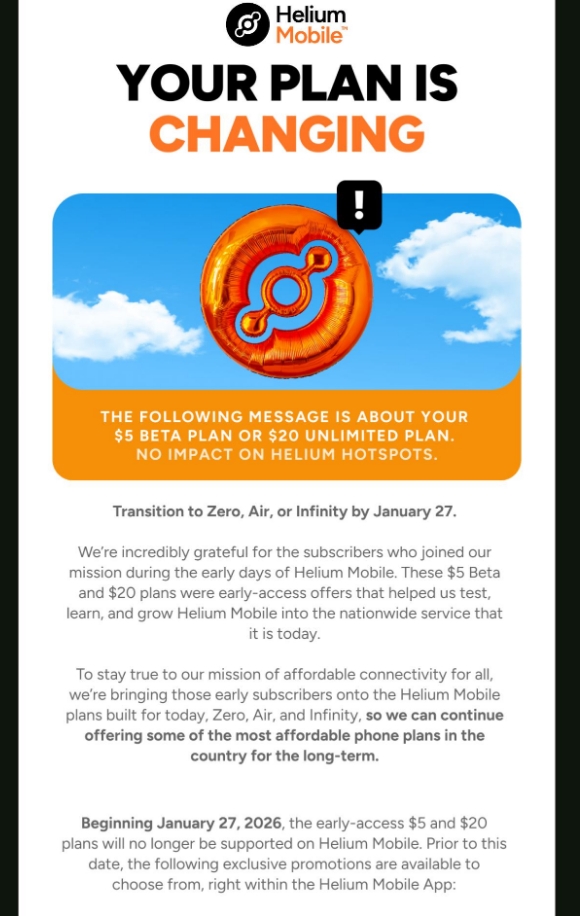
Helium Mobile Cancelling Beta Plans
Many users have voiced their dissatisfaction with this decision on Reddit, especially since Helium Mobile only gave existing users a 15-day notice. The general consensus among Reddit users is that they’ll be switching to different providers, as they feel like Helium Mobile went back on its promises in order to squeeze out extra money from people who helped it become what it is today.
New Helium Mobile Plans
As of April 27, 2026, Helium Mobile no longer offers the Zero (free) plan. The current plan lineup consists of:
Plan | Features | Price |
Air |
| $15/month |
Infinity | 36 GB of high-speed data and hotspot (then throttled); unlimited calls and texts | $30/month |
On paper, the new pricing plans look excellent, so why are existing users in an uproar?
For starters, all plans include fees and taxes, and the “free” Zero plan came with various strings attached:
- The Helium app and the enabled location caused quick battery drain
- You had to use cellular data each month; otherwise, your plan would be canceled
To make matters worse, the company required an ID verification to add a payment method to the supposedly “free” Zero plan. This was only required for the initial signup, and users who have already provided ID verification could simply add their payment method.
In retrospect, the Zero plan's complexity foreshadowed its retirement. After charging taxes and fees on the Zero plan starting January 27, 2026, Helium Mobile retired the plan entirely on April 27, 2026, only three months after introducing it.
The Infinity plan, which offers “unlimited” text, voice, and data, actually caps the monthly data at 36 GB. With other plans, you can purchase additional data at $7.50 per GB, but the Infinity plan doesn’t seem to offer that option.
All Helium plans also enable you to earn Cloud Points for completing specific tasks, such as referring a friend or using a certain amount of cellular data. You can exchange these points for gift cards for different stores and services, including Nike, Amazon, Uber, Chipotle, Spotify, etc.
Note that none of the plans earn crypto; for that, you’ll need to set up and maintain a Helium hotspot.
4. Customer Support
Helium Mobile’s customer support team is available via the following channels:
- Email: support@hellohelium.com
- Phone: (855)-775-6895
Unlike many other carriers, Helium Mobile doesn’t offer 24/7 support. The team is available during “normal business hours,” but the website doesn’t state what those hours are. Despite this, most Helium Mobile users are pleased with the team’s helpfulness and responsiveness.
The carrier also has a comprehensive help center where you can find more details about features, pricing, and add-ons, troubleshoot issues, or get answers to your questions.
Concierge support is also an option with Helium to assist all users who may feel overwhelmed by switching carriers. It’s completely free and available to those who need help with leaving their old carrier, bringing over an existing number, installing a SIM, or activating a new plan.
Helium Mobile Reviews: How Do Users Feel About It?
Even prior to the pricing plan changes, Helium Mobile customer reviews were a mixed bag.
Users generally praise the coverage, data speed, and customer support. Ease of setup is another advantage often mentioned across reviews; the process takes only a couple of minutes and is fairly straightforward.
Affordability was also one of Helium Mobile’s key strengths in the past, with users reporting they’ve saved a lot of money after switching to Helium, especially those who enabled mapping and successfully reduced their monthly bills. We’ll have to see whether this stays true in 2026, but most users are unhappy with the data limitations of the new plans.
Regarding negative aspects, several users reported issues with redeeming Cloud Points for gift cards. One user in particular states that Helium notified them that they had violated the terms and conditions without further explanation, so they were unable to receive gift cards. Another user had issues with redeeming points for referrals because the customer support kept using “rule changes” as an excuse.
For many users, the biggest concern is privacy. One subscriber mentions that Helium is invasive and requires sensitive information, as well as a range of permissions, to sign up and use the services.
The Verdict: Should You Use Helium Mobile?
Helium Mobile’s key selling point has always been affordability. While the free plan sounds great on paper, being limited to just 3 GB of data and having to pay $7.50/GB, plus additional fees and taxes, means you’re better off with the Air or the Infinity plans.
Apart from disliking the new pricing plans, many users also point out that Helium went back on its promises (lifetime $5 Beta and $20 Infinite plans), so the company has lost a lot of trust and goodwill with this sudden change.
The biggest downside and, for many users, a deal-breaker, is Helium Mobile’s privacy policy. The carrier collects vast amounts of user data, including their precise location to provide service, which is a direct invasion of privacy. Helium is transparent about its data collection practices, but the terms are unacceptable for privacy-conscious individuals.
Security is another issue. The lack of information on the exact security measures Helium Mobile uses to protect its subscribers is alarming and undermines user trust from the start.
In this YouTube interview with the GM of Helium Mobile Subscribers, Stetson Doggett explores the topic in more depth. One of the user comments sums it up nicely:

If you’re someone who values privacy and security, you should consider a Helium Mobile alternative that:
- Uses robust security and privacy protocols
- Has strict data collection policies
- Relies on an innovative infrastructure to reduce the risk of data breaches and leaks
The carrier that checks all the boxes is Cape.
Meet Cape: The Secure Carrier Designed for Today’s Threats
Traditional carriers collect detailed records of your calls, texts, and locations. That data becomes a liability—fueling surveillance, breaches, and leaks.
Cape takes a different approach. We’re a privacy-first carrier that collects only the bare minimum required to keep your service running. What little data is necessary is stored briefly, never shared, and never sold. With less data to compromise, you’re better protected from the start.
Like Helium, and many other smaller mobile carriers, Cape is an MVNO. However, there’s an important distinction: Cape is a heavy MVNO while Helium is a light MVNO.
Most MVNOs in America, including Helium, are light MVNOs, meaning they don’t own their towers and rent off other mobile network operators (MNOs). They also don’t own their own mobile core nor do they provision their own SIMs, which means they inherit the security weaknesses of the MNO’s network infrastructure.
Cape is unique because it is the only heavy MVNO in the country. This means that while we also don’t own our own towers, we actually do own our own mobile core and provision our own SIMs. With this infrastructure, we can actually implement a privacy-first network. Read our Cape mobile core blog post to learn more.
Cape’s mobile core was built from the ground up with security in mind. It’s cloud-native, software-based mobile core, which allows us to tackle security issues with more modern fixes. A mobile core is the backbone of a cellular network that controls the complex systems to connect people across endpoints. By running our own network, Cape can control how data flows through your device and implement modern security protocols.
Cape Features
Our service is built from the ground up with privacy and security at its core, offering unique features like:
Privacy & Security Feature | Description |
Cape doesn’t ask for your name, address, or Social Security number. We only collect the information necessary to provide service, and we retain that information for the minimum amount of time possible. | |
Traditional carriers rely on a fixed International Mobile Subscriber ID (IMSI) to connect your device to cellular networks. This is a vulnerability that lets carriers, advertisers, and bad actors identify and track your device. Cape lets subscribers automatically rotate their IMSI every 24 hours, making it infinitely more difficult to track you or your device. | |
Many services ask for your phone number, but sharing it exposes you to spam, scammers, data brokers, and a variety of other risks. VoIPs, on the other hand, don’t work with 2FA, cost extra, and aren’t encrypted. With Cape, you get two free additional SMS/MMS lines that are middle-to-end encrypted. | |
Most U.S. carriers store your call and text metadata for years, sometimes indefinitely. Cape is built to forget, so call data records (CDRs) are deleted after just 24 hours. | |
Cape nullifies the threat of SIM swapping by completely removing humans from the loop. During signup, you receive a 24-word phrase that generates a private key tied to your number. This effectively means that no one (but you) can move your number to a new carrier or device, not even Cape. | |
Legacy network protocols, like SS7, leave you vulnerable to hackers that can track your location, intercept your calls and texts, and steal sensitive information. Cape’s Network Lock relies on a proprietary signaling proxy to verify that your device’s physical location matches the network it’s trying to attach to. If we detect anything out of the ordinary, Cape automatically blocks the connection, nullifying the potential threat. | |
Traditional voicemail systems are outdated, unencrypted, and another security hole bad actors can exploit to gain access to your sensitive information. Cape encrypts all voicemails, ensuring only you can access them. | |
While roaming, your phone connects to local telecom providers to enable service. But, who knows who might be listening on the other end. Cape provides you with peace of mind by routing your traffic through our U.S.-based mobile core, ensuring your identity, data, and communications remain private and secure. |
Ditch Legacy Carriers: Get Cape Today
Cape is a “Heavy” Mobile Virtual Network Operator (MVNO), meaning we own our mobile core and provision our own SIMs. This gives us full control over how accounts are authenticated and what data is collected (and for how long), and is how we are able to provide privacy and security features no other carrier on the market can offer.
Get started with Cape today and enjoy the peace of mind, knowing you are fully protected against scammers, hackers, bad actors, and other mobile threats.
To help protect more than just your phone, we’ve partnered with Proton. As a new Cape subscriber, you can choose between Proton Unlimited and Proton VPN Plus for just $1 for six months.
Helium Mobile FAQ
What’s the best carrier to switch to from Helium Mobile if I’m using an eSIM?
What happens to my number, voicemail, and texts when I cancel Helium Mobile and move to another carrier?
Does Helium Mobile make it harder to leave than other MVNOs, or is number porting straightforward?
Has Helium Mobile service quality gone downhill recently?
What’s the easiest way to switch from Helium Mobile to a different carrier without overpaying?
Share it