
At Cape, we’ve always said that privacy shouldn't be buried in legalese. We believe privacy policies should be accessible and written in plain language—which is why we provide a summarized version of ours for anyone to read.
To put this to the test, we decided to run an experiment. We teamed up with our partners at Proton to hide an "Easter egg" inside our policy: a free round-trip getaway to Switzerland, the world’s privacy capital and where Proton is headquartered.
We wanted to see if anyone was actually reading. As it turns out, someone was.
Meet Our Winner (Anonymously)
After about two weeks since placing the Easter egg in our privacy policy, we received an email with the subject: “Free trip to Switzerland?!”
Our soon-to-be winner had stumbled upon a line in our privacy policy while she was doing what most people don’t: she was vetting her mobile carrier’s security claims. Having already adopted tools like Proton Mail, VPNs, and private browsers, she was looking for the final piece of her privacy puzzle.
While researching Cape, she dove into the fine print to see if we actually lived up to our promises. Tucked away in the text, she didn't find a dense paragraph about data-sharing or tracking; she found the Cape Experience Sweepstakes.
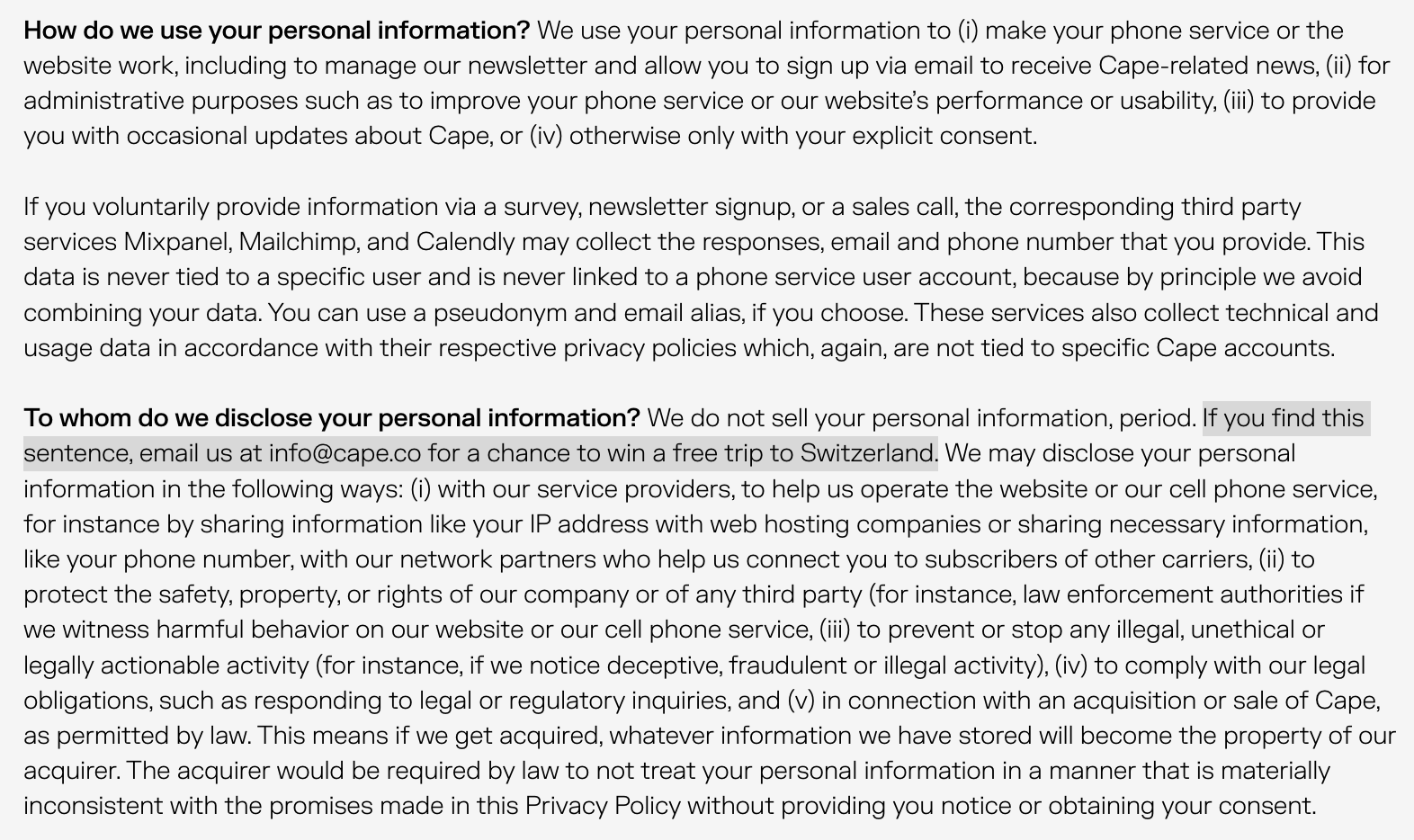
The prize included:
- Round-trip flights to Switzerland for two.
- Three nights in a private chalet.
- A $1,500 meal stipend and a private, chef-hosted dinner.
- Three years of Cape mobile service.
Our winner took her trip in December 2025 and captured the experience for us here:
The "Fine Print" Problem
The industry standard for privacy is broken. Most carriers rely on the fact that you won't read the fine print so that they can monetize your data by sharing it with their marketing affiliates or selling it to data brokers. According to an FTC report, as little as 0.5% of subscribers ever look at their carrier’s privacy policy.
This lack of transparency has real-world consequences. Our study with The Harris Poll (releasing soon) found that while most Americans don’t believe they’ve given carriers permission to share their location or browsing data, they actually have—the moment they activate their service. In 2024 alone, the FCC fined major U.S. carriers $200 million for illegally selling subscriber location data.
At Cape, we think that’s unacceptable. You shouldn’t need a law degree to understand what’s happening to your data.
As Patricia Egger, Proton’s Head of Security, puts it: “Companies should minimize the data they collect and apply end-to-end encryption wherever possible. Storing unnecessary personal information only creates risk—for users and for organizations.”
Our Swiss giveaway may be over, but our commitment to transparency remains. We are continuing to build the tools necessary to defend your privacy and secure your mobile data in a first-class way.
The next time you sign up for a service, take a look at the privacy policy. It might not always contain a trip to the Alps, but if you can't understand the jargon well enough to even find an Easter egg, chances are the company is trying to bury something in all the legalese.
Ready to switch to a carrier that puts you in control? Switch to Cape.
Share it